The wattage printed on a solar panel is a useful number, but it has a narrow job. It tells us how much direct-current power that module can produce at a specified operating point under agreed test conditions. It does not describe a cloudy morning, a hot roof, or the electricity an inverter delivers across a year. The distinction matters because a panel can be healthy and still spend most of its working life away from the conditions in which its rating was measured.
The agreed conditions have a name: standard test conditions, or STC. They use sunlight striking the module at 1,000 watts per square metre, a reference solar spectrum called air mass 1.5, and a cell temperature of 25°C. That last word deserves attention. It is the temperature of the working photovoltaic cells, not the air beside the roof. The rating describes the module's maximum power point under those conditions: the combination of current and voltage that produces the most power at that moment. NREL's PVWatts technical manual treats the nameplate as a starting DC capacity and then models the changing conditions that stand between that capacity and delivered energy. A common standard makes one module comparable with another; it does not make the outdoor world hold still.
The light that reaches the glass
The first change occurs before electricity exists. A weather report may describe a sunny day, but the relevant quantity for a panel is the light arriving on its own tilted surface. The sun moves across the sky while a fixed roof keeps the same orientation. At one hour, the direct rays may approach the glass nearly squarely; later, they strike at a slant. The panel then intercepts less direct light per unit of its surface, and reflection at the cover can change too. The sky also supplies diffuse light that has been scattered by air, cloud and other material, while the ground can reflect some light back toward the module. The Department of Energy's explanation of solar radiation separates direct and diffuse sunlight and describes why location, season, hour and weather alter the available resource. Those ingredients explain why the same installed panel can have a very different midday in winter and summer without changing at all.
Clouds do more than dim a lamp uniformly. A thick cloud can remove much of the direct beam, while a thinner or broken cloud changes the balance between direct and diffuse light. A passing edge can make power move quickly; a day with steady haze can hold it lower for hours. What matters is not the label “sunny” or “overcast” but how much irradiance reaches the plane of the array, and for how long. This is why NREL's System Advisor Model technical reference includes weather inputs, shading and plane-of-array irradiance before it calculates module output. A horizontal sunlight measurement by itself cannot be read as the irradiance on a sloped roof.
Shade is a separate, more local problem. A branch, parapet or nearby building can interrupt sunlight on part of an array while the rest remains bright. The effect depends on which cells and modules are shaded and how the electrical system connects them. In NREL's 2012 shading testbed, researchers compared identical arrays using different power-conversion arrangements under repeatable shade patterns. Their results show why a simple statement such as “one shaded panel costs one panel's output” is unreliable: the electrical arrangement changes how a local shadow affects the system. The testbed's numerical gains belong to its tested systems and shade patterns; a roof needs its own shade survey.
Light warms the machine that catches it
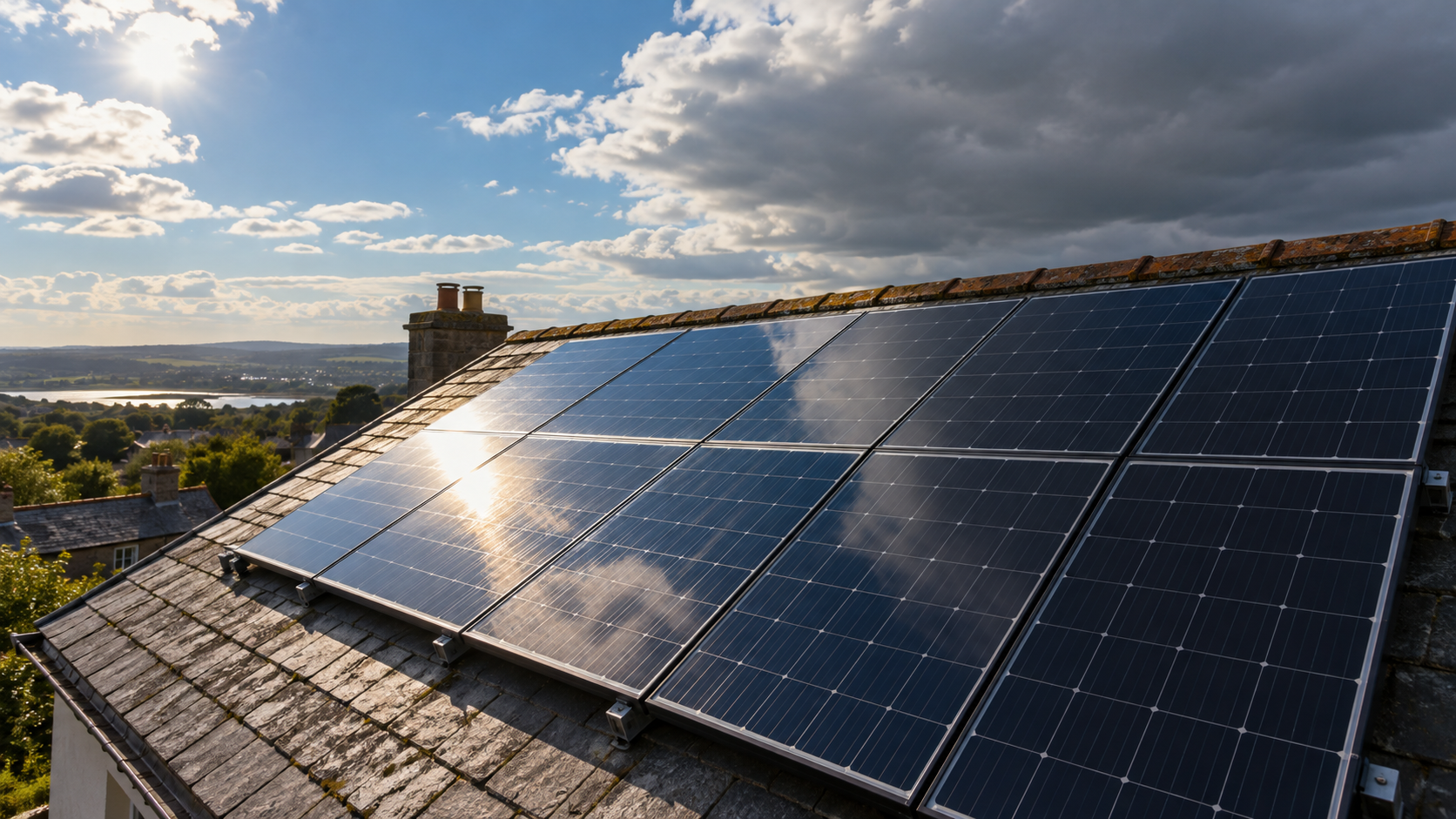
Even in full sun, the cell may be far from 25°C. Much of the light that a solar cell absorbs becomes heat. On a warm, still roof, the operating cells can run hotter than the surrounding air; wind and the space behind a module influence how readily they cool. The Department of Energy's explanation of photovoltaic efficiency describes the electrical reason heat matters: for common solar cells, rising temperature increases current slightly but reduces voltage more, lowering maximum power. NREL's PVWatts manual accordingly calculates operating cell temperature from the sunlight, air temperature and wind rather than substituting the day's air temperature for it.
Module specifications express part of this response with a temperature coefficient of maximum power, usually stated as a percentage change per degree Celsius from the reference cell temperature. The coefficient is a way to estimate the temperature effect at comparable irradiance. It is not a percentage to subtract for every degree of outdoor air above 25°C, and different module technologies have different coefficients. Nor does it mean that a cold, dark day beats a hot, bright one: less light may outweigh the efficiency gained by cooler cells. The 2018 NREL model reference handles temperature and irradiance as related inputs rather than treating one thermometer reading as a prediction of output.
This is the subtle trade in a clear summer afternoon. There may be ample sunlight on the glass, yet the cells themselves grow warmer and convert each unit of that light less effectively. A cool, bright interval can favour electrical efficiency, but the actual output still depends on how much light arrives. The module does not have two independent dials marked “sun” and “temperature.” Sunlight changes both the available input and the heat load; wind and mounting change the latter. A reading at the wall socket hides these intermediate steps.
From a module's watts to a year's electricity
The rated panel supplies DC power. A grid-connected system generally sends that DC through cables and connections to an inverter, which converts it to AC power. Resistance in wiring and losses at connections have their own effects; the inverter has an efficiency that varies with operating level and a rated AC capacity. NREL's PVWatts manual explicitly separates system losses such as wiring and mismatch from its inverter model. If the calculated AC output rises above the inverter's nameplate limit, the model caps it there. The Department of Energy's solar-cell primer follows the current from connected cells through a module and onward to the inverter. Adding the DC ratings of modules therefore gives an array's nominal DC size, not an assurance that the same number of watts will appear as AC at a meter.
The units make another difference easy to miss. A watt is a rate of producing electricity at an instant. A watt-hour measures energy produced while that rate continues over time. If power changes through a day, the energy is the accumulation of all those changing intervals, not the highest reading multiplied by a convenient stretch of daylight. A kilowatt of installed DC rating and a kilowatt-hour of AC energy answer different questions. The 2022 federal PV performance assessment compared measured production with models using coincident sunlight and temperature data across hourly, daily and monthly periods; it also accounted for inverter capacity and other system characteristics. That is the level at which an energy prediction has meaning.
It is tempting to turn the nameplate into a promise by applying one fixed discount. That loses the useful part of the problem. Shade can change with the hour and the season; heat follows sun, air, wind and mounting; the inverter's behaviour depends on its own rating and the DC power offered to it. A model can combine local weather records, orientation, shade and equipment specifications to estimate future energy, but even a careful model carries uncertainty about future weather and the installed system. The NREL shading study is a reminder that the layout and electronics matter, while the federal performance study shows why observed output is compared with conditions at the same time, rather than with a bare nameplate figure.
The panel rating remains valuable precisely because it is controlled. It gives the designer a common reference and gives the owner a way to identify the equipment. To ask what the system will produce, follow the light to the tilted glass, follow the heat into the cells, and follow the current through the wires and inverter. The weather supplies the changing input; the installation decides what it can make of it. The number on the panel is where that accounting begins.
A thought worth keeping?