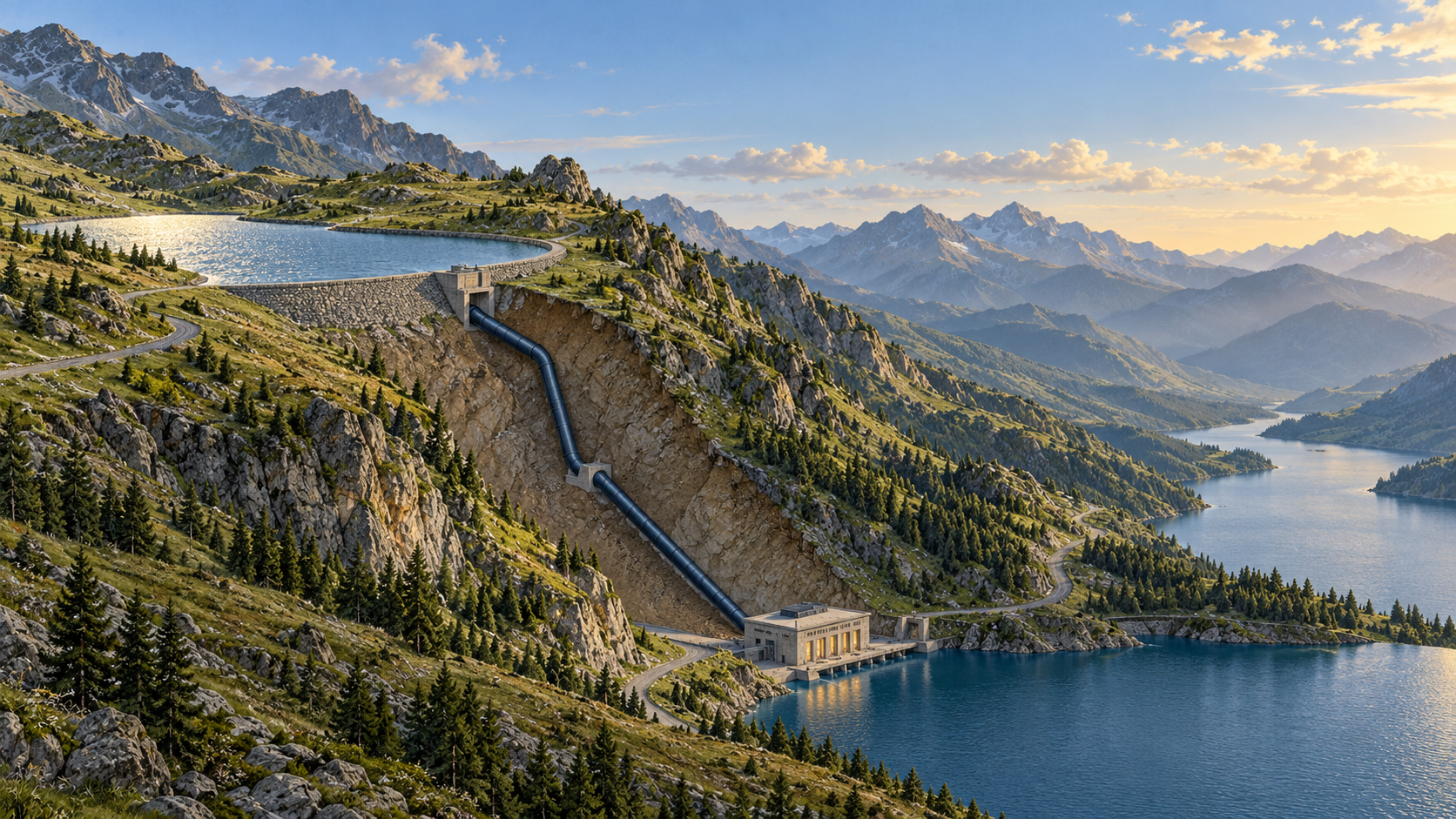
From a distance, pumped storage can look like ordinary hydropower: water above, a powerhouse below. The revealing part is the return journey. When electricity is plentiful, the plant spends some of it lifting water uphill. Later, it lets that water descend through a turbine and returns electricity to the grid. The arrangement needs two places to hold the water, a usable height between them, and a route that works in both directions. The US Department of Energy’s technology assessment describes the upper and lower reservoirs, connecting waterways, and generating and pumping modes as the basic scheme. The plant stores energy in a changed position, not in a changed substance.
The work done on the way up
In pumping mode, electricity drives a motor and pump that move water from the lower reservoir to the upper one. The water gains gravitational potential energy because it is now higher. In generating mode, it flows back down a tunnel or pressure pipe, turns a turbine, and drives a generator. Many plants use a machine that can act as both pump and turbine; others use separate equipment. That distinction matters whenever a neat drawing of one reversible wheel is mistaken for the only possible design. The DOE assessment explicitly describes both arrangements.
Water is the carrier of that energy. If it starts and ends a cycle in the same lower reservoir, the cycle has not manufactured new electricity. It has moved an opportunity to generate from one hour to another, at a cost. Pumping consumes more electricity than the later descent returns, because motors, pumps, turbines, generators and flowing water all have losses. DOE estimated that a typical new plant had round-trip efficiency around 80% in its 2023 assessment; that is a technology estimate, not a promise for any site or operating pattern. The reason to run such a plant is that electricity delivered at the later hour, or the ability to respond then, can be worth more to the system than the energy used earlier. Argonne’s valuation guidebook treats energy shifting alongside capacity, reserves, regulation and other services, each with its own conditions and costs.
The size of the reserve and the speed of its release
The height difference between the water surfaces is called the head. Greater head gives each unit of water more potential energy. Greater usable water volume gives the plant more units of water to move. Those two properties largely set the energy available from a full upper reservoir, after allowing for conversion losses. They do not, by themselves, tell us how fast the plant can deliver it. The turbine, generator and water passage set the practical rate of flow and electrical output. The distinction is the same as the difference between an amount of energy, measured in megawatt-hours, and power, measured in megawatts: a reserve and the rate at which it can be drawn down.
An Argonne and National Renewable Energy Laboratory study of Alaska calculates modeled storage capacity from water volume and average head, with explicit assumptions about usable water and efficiency. Its equation is useful because it shows which physical quantities matter; its chosen dimensions and percentages belong to that model. The National Renewable Energy Laboratory’s closed-loop resource dataset similarly records candidate reservoir pairs by water volume, head and distance, then represents each modeled pair as a ten-hour system. Ten hours is a sizing choice for that assessment. A different powerhouse size on a suitable pair would change rated power and the time to empty the available reserve. It would not conjure more water or elevation.
Even “full” is less simple than it sounds. Only water that can be moved within the permitted and engineered operating range counts as usable storage. As the upper level falls and the lower level rises, the head can change. The effective reserve therefore depends on actual levels and operating constraints, rather than one permanent number painted on a sign. Those constraints are a reminder that a pumped-storage plant is a machine fitted to a landscape, not a generic battery whose capacity can be read from its reservoir area alone.
What the grid can ask of it
The classic drawing shows a pump running at night and a turbine running by day. That pattern is possible, but the clock is incidental. A plant may pump when the grid has inexpensive or otherwise surplus electricity, including periods of strong wind or solar production, and generate when electricity is needed. The relation between those periods changes with the grid. A hydropower plant with natural inflow may also generate some electricity from water that was never pumped; that is a different contribution from the stored-energy cycle, as DOE notes for pump-back configurations in its technology assessment.
Power equipment changes the plant’s choices. A conventional fixed-speed unit can vary output while generating but generally draws a much less flexible amount of power while pumping. Adjustable-speed machinery can vary pumping load as well, according to the DOE assessment. A National Renewable Energy Laboratory technical report analyzes how adjustable-speed electrical systems can support grid response. Neither capability is implied merely by seeing two reservoirs on a map. Operators also have to keep enough water, machine capacity and permission to generate when they promise reserve or regulation. Argonne’s guidebook points out that committing a unit to one service can limit the energy it can sell through another.
The water has to belong somewhere
Two reservoirs need not mean two new dams. Some designs use an existing water body; others construct both basins or adapt a mine pit. What matters for storage is the workable pair and the connection between them. An open-loop project is continuously connected to a naturally flowing water body. A closed-loop project keeps its reservoirs away from such a continuous connection. Those are distinctions in hydrology, not labels for good and bad projects. The Federal Energy Regulatory Commission’s 2019 guidance describes a closed-loop project that may still withdraw surface water or groundwater for its first fill and periodic recharge.
That last point corrects a seductive image of a perfectly sealed circle. Water can evaporate or seep; the source used to replace it and the place used to hold it deserve scrutiny. FERC lists possible effects on groundwater levels, surface-water flows and water quality, aquatic life, land and cultural resources when assessing proposed closed-loop projects at abandoned mines. These are questions for a particular site, not proof that every project will have every effect. Likewise, a technically plausible reservoir pair is not automatically an economical plant. The Alaska study found that access, existing infrastructure, reservoir scale and local electricity needs change the result, especially for smaller isolated systems.
The two reservoirs are therefore the beginning of the story, rather than a complete specification. Between them sit the head that makes stored energy possible, the machinery that fixes its delivery rate, the losses paid on every round trip, and a watershed with its own demands. Pumped storage is most intelligible when all four are kept in view: water lifted now, water returned later, electricity lost in the exchange, and useful flexibility gained at the hour it is needed.
A thought worth keeping?