The meter at a wind farm has two directions to watch. When the turbines make more electricity than the site needs, power leaves for the grid. When the wind falls and the machines stop generating, the same operating site may need power sent back to it. Blades resting against the sky do not mean the control room, pumps, heaters or turbine controls have gone to sleep. The electricity a wind farm uses itself is a small but real part of its energy story, and it changes with the weather, the equipment and where someone chooses to measure it.
At the Wind Energy Institute of Canada's 10-megawatt research park on Prince Edward Island, the question appeared as an electricity bill. The park had five turbines and a battery that researchers hoped could supply internal demand through calm periods. Their original account of a 2014 trial says the turbines and substation needed purchased electricity to run pumps, heaters and yaw drives when wind production was low. That list gives the subject its scale: the machine does not burn fuel to make electricity, yet it contains smaller machines that use electricity to keep it ready and safe.
What remains on when generation falls
The yaw drive turns the turbine's housing to face changing wind. Pumps may serve hydraulic equipment or cooling circuits; heaters protect equipment in cold conditions. The exact combination depends on turbine design. A National Renewable Energy Laboratory study of one Vestas V-27 turbine, prepared for a proposed offshore test platform, describes actively controlled blade pitch and a possible brief transition between generating and drawing power in low wind. Its simulation deliberately limited that transitional motoring and could shut down an inverter when the turbine was off to avoid its own idle loss. This is a useful reminder about control settings, not a claim that every modern turbine motors itself through a lull or has the V-27's arrangement.
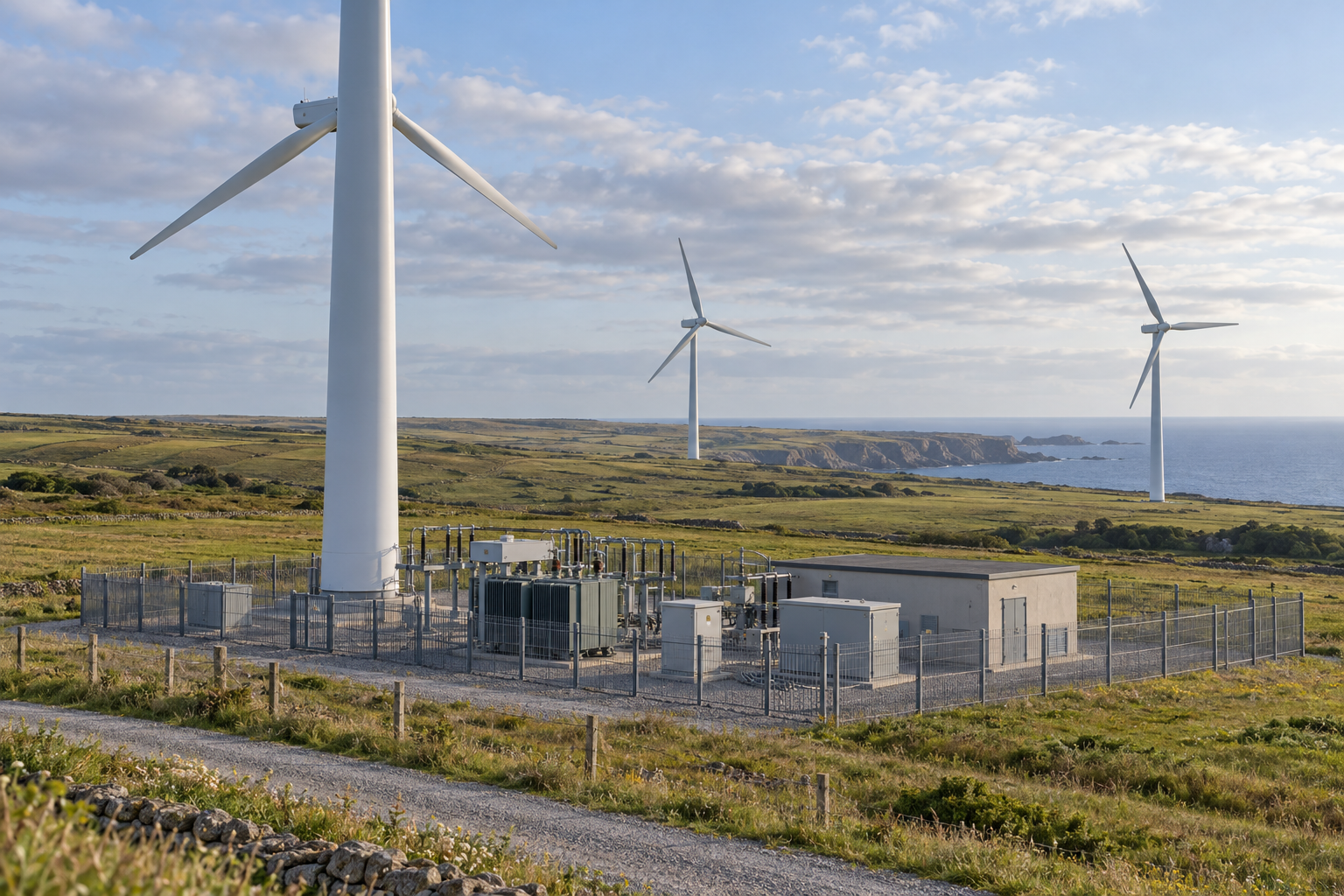
Some loads belong to the farm rather than an individual tower. The substation gathers the turbines' output and provides a place for switching, protection and control. The Prince Edward Island researchers' one-line diagram includes the wind turbines, substation, battery and utility connection on the same electrical network. In a 2024 design statement for the proposed Outer Dowsing offshore wind project, the onshore substation plans a normal auxiliary supply from the distribution network and backup generation for the control room, lighting and control functions if that supply fails. It is a proposed design, not a measured consumption figure. It shows why a wind farm's need for electricity cannot be read only from the rotor: the grid connection and its protective equipment have their own working life.
The source of this service power changes with the moment. During a productive hour, some wind-generated electricity can run the site's loads before the remainder is exported. During a calm hour, a grid-connected site can import electricity for those same loads. A backup generator or battery may serve a defined need, but neither makes the underlying demand disappear. The Prince Edward Island park's battery was charged from its wind output and discharged into its internal network when the park's net power turned negative. That choice changed the timing and source of its imports; it did not make the yaw motors or substation equipment stop needing energy.
A month's bill is not an annual percentage
The institute published a table of electricity bought by the park in the ten months from April 2013 through January 2014, before its storage system was operating. Monthly imports ranged from 6,642 to 16,276 kilowatt-hours in that sample. In December 2013 alone, the park bought 7,764 kilowatt-hours while its turbines produced 4,496 megawatt-hours. These figures come from the institute's white paper. The import figure records electricity supplied from outside during periods when the site needed it; it does not count all electricity the farm used internally while it was generating. Dividing imports by the month's turbine production would therefore understate total station use.
Power and energy also describe different parts of that bill. A kilowatt is the rate at an instant; a kilowatt-hour accumulates that rate over time. The paper reports December 2013's highest measured demand as 141.8 kilowatts, but the site did not hold that draw for the entire month. A short peak can matter for a demand charge even when the month's purchased energy is modest. A long calm spell can have the opposite character: a steady, smaller load adds kilowatt-hours while the turbines remain idle. The tariff in this particular Canadian trial priced both quantities, which is why its researchers were interested in a battery even though the wind park was a substantial net producer over the year.
That battery experiment makes an unusually clear accounting test. In December 2014, stored wind energy displaced 8,705 kilowatt-hours that otherwise would have been bought during low wind. But the storage system absorbed 29,806 kilowatt-hours and released 16,580, much of it to the turbines and grid. Its heated battery modules used energy while waiting; the report calculated an overall monthly storage efficiency of about 56 percent. The trial reduced a purchase but lost energy in the storage process and did not remove the demand charge. A later two-month study reported by the institute found 17.2 megawatt-hours of import avoided, yet again could not avoid the demand charge, and the financial benefit did not cover the storage system's energy losses. Those results belong to that battery chemistry, control scheme, tariff and weather; they are not a verdict on every wind-farm battery.
The load can change with the season
Cold weather can add a load that a mild-climate farm never has. In a 2024 field test on a two-megawatt turbine in China, researchers used heated air inside blades to prevent or remove ice. Under the reported test conditions, heating power was below 50 kilowatts, and thick ice began to melt and shed after two hours of continuous heating. That number describes one tested system and condition. It cannot be pasted into every turbine's winter energy budget, but it makes the trade visible: electricity spent on ice protection may allow the turbine to keep producing or return to service sooner.
Weather can remove production while some auxiliary demand persists. It can also change which auxiliaries run: heating in ice, cooling in heat, yawing with a shifting wind. The design of the turbine and substation sets another part of the answer. A blanket claim that wind farms consume a fixed share of their own output would have to ignore the length of calm periods, the site's climate and the equipment actually installed. The useful question is more local: which loads run in each operating state, how much power do they draw, and how often does that state occur?
Count the right losses
It is easy to confuse self-use with every other reason less power reaches the grid than a turbine's nameplate suggests. The National Renewable Energy Laboratory's wind-model guidance separates facility parasitic consumption from electrical efficiency losses between equipment and the measurement point. It also treats downtime, curtailment, weather damage and wakes as different sources of reduced energy. A cable warming as current passes through it is an electrical loss; a pump running in a nacelle is a load; a turbine stopped for maintenance is a lack of generation. They may all reduce delivered energy, but they call for different explanations and remedies.
The distinction matters when comparing projects. A 2026 Pacific Northwest National Laboratory analysis estimated an observation-based median loss factor of 17 percent for its sample of small, single-turbine installations. That figure combines departures from expected production, including factors beyond auxiliary electricity. It is not a measurement of how much power those turbines used to run themselves, and it is not a percentage to assign to a utility-scale wind farm. A useful site report keeps gross turbine generation, electricity used on site, imports, exports and other energy losses distinct, with the meter locations and time period stated.
Wind supplies the energy that the farm sells, but the farm is also an electrical workplace with motors, controls and protective equipment. Its quietest hour can be the hour when that fact is easiest to see: a blade motionless, a control circuit awake, and power crossing the boundary in the other direction. The meter is telling two stories over time. Reading both is how the electricity used to make electricity stays in the account.
A thought worth keeping?