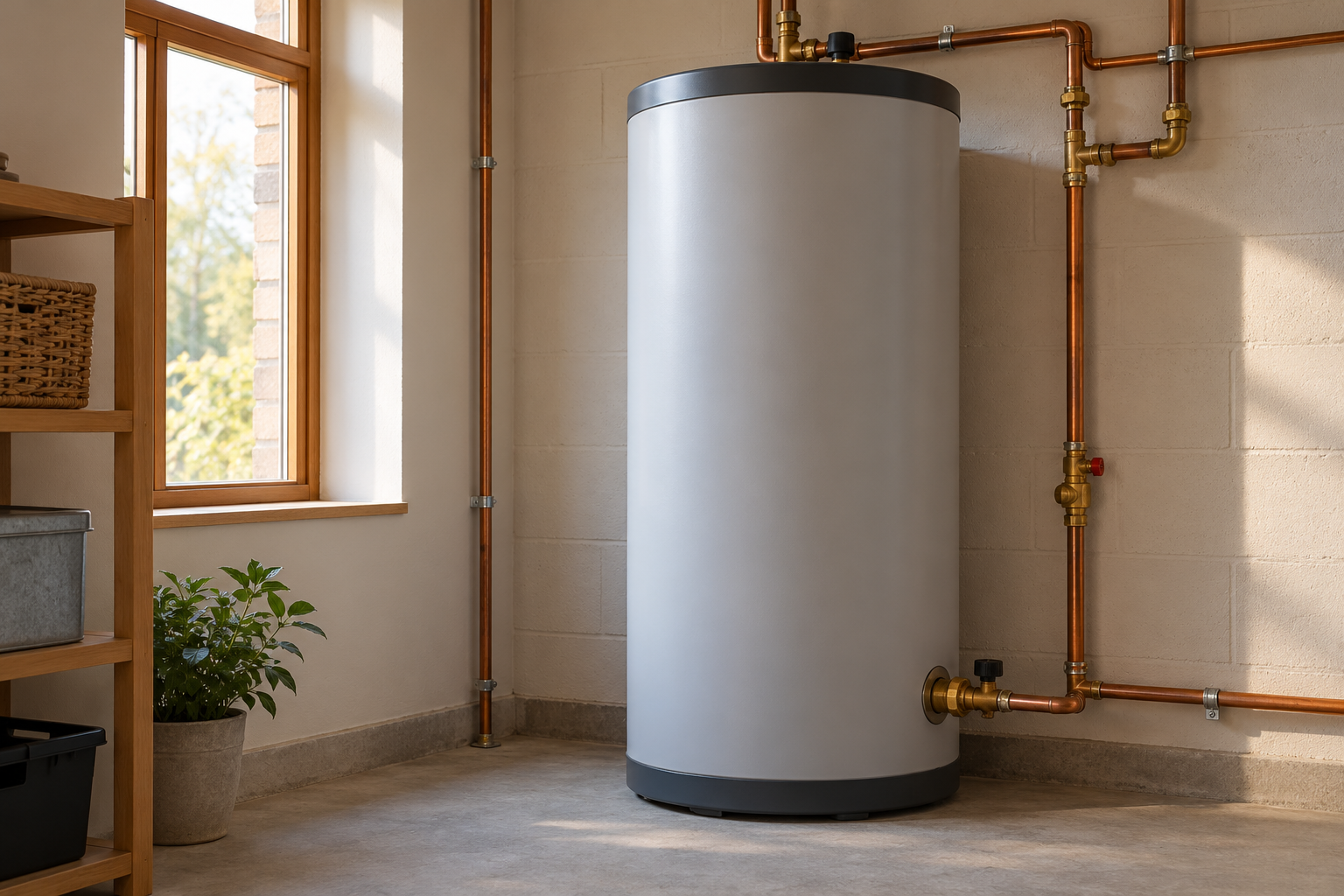
A hot-water tank can feel full long after its heating source has stopped. The water has not vanished, and the cylinder still feels warm. Yet the next draw may turn cool sooner than its volume suggests. A tank stores heat, but a tap or heating circuit needs that heat at a usable temperature. The difference between those two statements is where much of the tank's practical capacity lives.
Water is an effective store because a small rise in temperature holds a substantial amount of energy. The International Energy Agency's 2022 fact sheet gives a useful scale: heating one litre of water by one degree Celsius stores about 1.17 watt-hours. A hundred litres raised by ten degrees therefore hold about 1.17 kilowatt-hours more heat. That arithmetic counts energy added to the water. It does not tell us how much of that energy can leave the tank at the temperature the next job requires.
Imagine a closed heating buffer divided into two equal layers: the upper half at 60°C, the lower half at 30°C. Its average temperature is 45°C. Stir the layers thoroughly and the average remains 45°C; no heat has disappeared in that idealized instant. But if a connected circuit needs a 50°C supply, the original hot upper layer could serve it for a time, while the stirred tank cannot deliver that temperature without reheating. The numbers are an illustration, not a recommended setting for any real system. They show why the place of the heat matters as well as the total amount.
A quiet boundary inside the cylinder
Hotter water is usually less dense than cooler water, so it tends to sit above it. Between warm and cool zones lies a transition region, often called a thermocline. As hot water is drawn from near the top and cooler replacement water enters lower down, that boundary can move through the tank. It is not a rigid wall; water and heat cross it, especially when inlet flow stirs the layers. The IEA's sensible-water storage account explains why designers try to reduce that mixing: if hot top water is blended prematurely with cooler water below, the delivery temperature falls even though the heat is still in the tank.
This behavior is measurable, not only a diagram. Krafčík and Peráčková's 2019 laboratory experiment followed temperature at 13 heights in a 1,050-litre water store. They varied the flow from the heat source between 250 and 1,000 litres an hour and observed how the temperature layers formed over an hour. Their apparatus used internal elements to guide water toward layers of similar temperature. It was a large experimental store, so its numbers should not be mapped onto a household cylinder. What it makes visible is the tank's hidden vertical structure: one temperature probe cannot describe all of its water.
How water enters matters as much as where it leaves. In a controlled solar-tank experiment, researchers compared a direct inlet with perforated and slotted inlets during discharge. The latter two preserved stratification more effectively in their test tank. At a flow of five litres per minute, the perforated inlet improved their measure of effective discharge by 21% against the direct inlet; at fifteen litres per minute the difference was 40%. Those are comparisons within a specific small apparatus and its definition of effective delivery, not a promise for a different cylinder. They illustrate the mechanism: a fast incoming jet can spend useful hot-water capacity by mixing it away.
A tank is seldom drained in one smooth laboratory run. People or heating controls draw, pause and draw again. A 2019 experiment with intermittent hot-water use varied flow rates and waiting intervals. Greater flow and longer waits thickened the mixed transition zone under its test conditions. Flow can stir the boundary; time lets heat move across it. The result does not make a pause undesirable in itself. It shows why the temperature available at the outlet depends on the draw pattern, not just on the temperature at the start of the day.
That distinction also appears in how capacity is counted. In a 2022 proposed water-heater test procedure, the US Department of Energy argued that a tank's nominal volume alone does not describe how much hot water it can deliver. The proposal discussed an effective storage volume that reflects both stored volume and temperature, particularly when a heater stores water hotter than its delivery setpoint. It was a proposal about test methods, not a rule of thumb for sizing a particular tank. Its physical point is sound: two equal-size vessels can offer different useful draws if their stored temperatures differ.
Time spends heat too
Even a well-stratified tank cannot hold its heat forever. Heat passes through insulation, fittings and connected pipes to cooler surroundings. The higher the stored temperature above the room, the greater the driving difference for loss; insulation and tank size shape the rate. The IEA fact sheet gives broad ranges across very different stores and explicitly warns that their boundary conditions vary. A precise daily-loss figure for one cylinder cannot be borrowed from another.
The heater itself can add another path. Lawrence Berkeley National Laboratory modelled a conventional gas storage heater in 2009. In its specified 24-hour test simulation, heat leaving through the flue while the burner was not firing was larger than the heat lost through the insulated jacket. The study describes a particular older, natural-draft gas design and test cycle; an electric or heat-pump cylinder has a different arrangement. It is a reminder to trace every route out of storage, including the equipment attached to the tank, rather than treating the metal shell as the whole loss story.
Stored heat can also become less useful without leaving the tank. When the warm top and cool bottom blend, the water's average energy may remain nearly the same for the moment, but its highest available temperature falls. Later, ordinary heat loss lowers both the amount and the temperature. These processes are different: one redistributes heat inside the vessel; the other transfers it away. A tank can suffer both while waiting to serve its next demand.
That is why the meaningful question at the end of a sunny afternoon is not simply how many litres the solar-heated store contains. Ask how hot the upper water is, how much of it can be drawn before the transition reaches the outlet, what temperature the next use needs, and how long the heat must wait. The water left below the useful threshold is not devoid of energy. It has heat of a lower temperature, and a different use or another heating step may be needed to make it valuable. The cylinder holds a quantity of water; its layered temperatures determine what that quantity can still do.
A thought worth keeping?